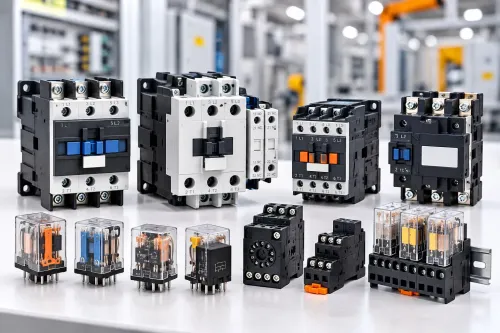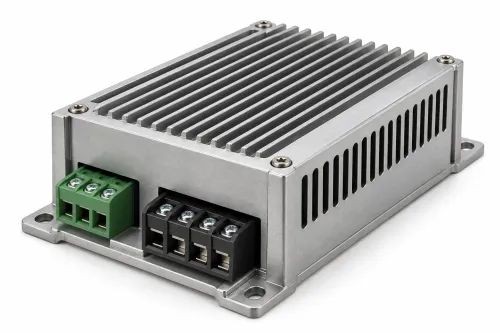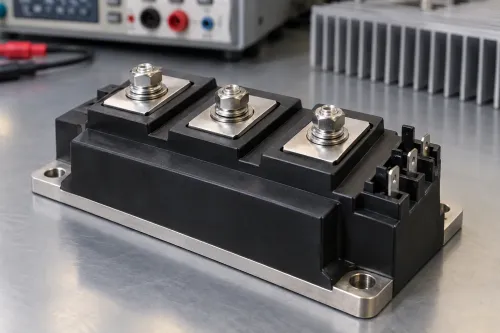
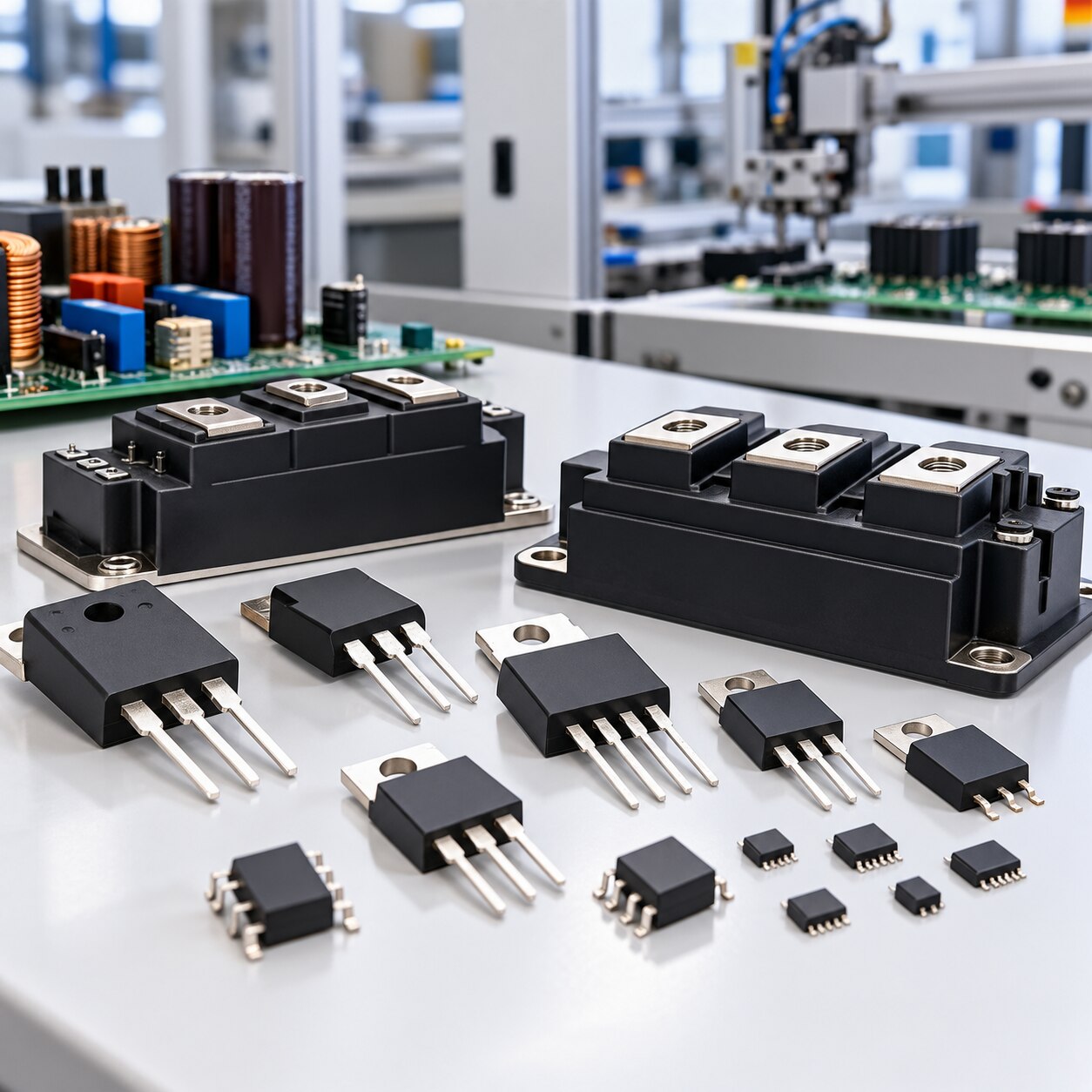
OEM buyers in Delhi can source these devices through authorised distributors, local stockists, specialist importers, and direct manufacturer channels, but each route carries different risks for traceability, lead time, and production continuity. By the end, you will know how to compare MOSFETs and IGBTs for your topology, specify a quotation, inspect incoming stock, and choose a supply route that can support production.
Key takeaways
- Choose suppliers by continuity, traceability, and production risk—not unit price.
- Use MOSFETs for faster switching; choose IGBTs for higher-voltage, lower-frequency loads.
- Compare RDS(on), VCE(sat), gate charge, voltage ratings, and thermal limits.
- Approve stock only after checking date codes, lot traceability, packaging, and electrical samples.
Which Delhi sourcing channel fits an OEM production order?
Choose the channel by production risk, not by the lowest unit price. A MOSFET and IGBT supplier in Delhi may offer immediate stock, while a factory-authorised route offers stronger continuity for repeat builds.
| Channel | Strength | Best fit |
|---|---|---|
| Authorised distribution | Traceability and manufacturer-backed documentation | Production qualification |
| Delhi-based stockist | Fast local collection and replacement | Urgent samples or line-down support |
| Specialist importer | Access to difficult or allocated parts | Controlled imported supply |
| Independent broker | Spot-market access | Obsolete or constrained parts after verification |
| Manufacturer or factory-authorised route | Defined lead time and continuity plan | Repeat OEM production |
An authorised source should provide manufacturer traceability, the exact part number and revision, date and lot codes, a certificate of conformity where applicable, and a documented returns process. A warehouse address or physical stock does not prove authenticity.
A power semiconductor distributor in Delhi should also state whether the quotation is warehouse stock, distributor stock, or factory lead time.
Require these details before approval:
- Quantity physically available, warehouse or distributor location, date codes, country of origin, storage history where relevant, and replenishment lead time
- Commercial invoice, packing list, and importer-of-record details
- Customs documentation and applicable tariff classification
Reject claims that stock is “duty-free” or “already cleared” unless the quotation identifies the customs basis. Use local supply for urgent samples and line-down recovery; accept factory lead time for repeat production when it secures consistent lots, lifecycle visibility, and planned replenishment.
How do you choose between a MOSFET and an IGBT for the load?
Choose by voltage, switching frequency, topology, and losses—not by headline current. MOSFETs suit lower- to medium-voltage, high-frequency DC-DC converters, PFC stages, battery systems, and many UPS designs because conduction loss follows I²RDS(on). IGBTs suit higher-voltage, lower-frequency solar inverters, motor drives, industrial inverters, and welding equipment, where VCE(sat) and switching energy dominate.
Induction heating usually favours MOSFETs at higher frequency, but IGBTs fit lower-frequency designs.
| Device | Best fit | Main trade-off |
|---|---|---|
| MOSFET | High-frequency, lower/medium-voltage switching | RDS(on), gate charge, and body-diode reverse recovery |
| IGBT | High-voltage, lower-frequency switching | VCE(sat), turn-on/turn-off energy, and diode behaviour |
Specify these before asking a mosfet supplier in delhi or an IGBT supplier for OEM:
- Drain-source or collector-emitter voltage, including DC-link overshoot and other design transients
- Continuous and pulsed current, switching frequency, duty cycle, and maximum junction temperature
- MOSFET gate threshold, recommended gate voltage, total gate charge, and body-diode reverse-recovery data
- IGBT gate-emitter limits, total gate charge, short-circuit withstand time, and the specified anti-parallel diode
An IGBT current rating is not an independent continuous operating limit. Junction and case temperature, gate resistance, switching frequency, duty cycle, thermal interface, and the manufacturer’s derating curves determine usable current; validate those conditions in the OEM test plan. Compare loss calculations at the actual operating point, not unit price or package appearance.
Which datasheet figures and gate-drive conditions should you compare?
Compare only datasheet values measured under equivalent conditions. For a MOSFET, match RDS(on) at the same drain current, gate voltage, case temperature, and assumed junction temperature. Do not compare a typical value at 10 V with a maximum value at 4.5 V.
| Device | Compare under the same conditions | Main loss estimate |
|---|---|---|
| MOSFET | Drain current, VGS, case temperature, junction-temperature assumption, switching voltage and frequency | I²RDS(on), plus switching, body-diode reverse-recovery, and gate-drive losses |
| IGBT | VCE(sat), current, gate resistance, DC-link voltage, junction temperature, turn-on and turn-off test setup | VCE(sat) × current, plus turn-on and turn-off energy multiplied by switching frequency |
For an igbt supplier for oem, require the complete switching test conditions, not only collector-current and voltage ratings. A current figure measured at 25°C cannot validate operation at the planned junction temperature, gate resistance, duty cycle, and frequency.
- Confirm the recommended gate voltage and maximum VGS or VGE.
- Compare total gate charge, Miller plateau voltage and duration, and the specified gate-resistor range.
- Check whether the driver needs separate turn-on and turn-off resistance, negative bias, or an isolated supply.
- Verify negative-gate-bias limits, desaturation protection requirements for IGBTs, and undervoltage-lockout behaviour.
Then calculate losses at the real operating point. A same-rating substitute can demand more peak gate current, overload the driver, increase reverse-recovery loss, or miss the switching-speed target.
Will the device fit the board and survive its thermal environment?
A quotation cannot prove that a device fits your PCB or survives its enclosure temperature. Check the datasheet drawing, pinout, tab potential, creepage, clearance, mounting method, recommended land pattern, and rework process before approving a substitute.
| Package | Mechanical and insulation checks | Mounting and rework |
|---|---|---|
| TO-220 | Confirm pin order and whether the tab is drain or collector; maintain creepage and clearance from the heatsink | Use an insulated pad, shoulder washer, screw and specified torque; desolder leads individually |
| TO-247 | Check the wider lead pitch, tab potential and PCB edge clearance | Bolt to a heatsink or cold plate; use a pad and bushing where the tab is live |
| D2PAK | Verify the exposed tab potential, copper area, creepage and clearance | Solder the manufacturer’s land pattern; rework with controlled hot air or preheating |
| PowerSO-8 | Check pin numbering, exposed pad potential and thermal copper | Use the exact stencil and land pattern; pad removal makes rework difficult |
| SOT-23 | Confirm pinout, narrow spacing and voltage-dependent clearance | Use the specified small land pattern; replace with hot air and microscope inspection |
| Module | Check terminal arrangement, isolation barriers and baseplate clearance | Follow the mounting pattern, washers and torque sequence; replace as a complete unit |
For industrial igbt components india module RFQs, specify topology, blocking voltage, nominal current, internal diode, thermistor availability, terminal arrangement, isolation rating, baseplate dimensions and mounting pattern.
Estimate conduction loss plus switching loss, then select the heatsink or cold plate, thermal interface material, case-to-sink resistance and airflow. Check junction-to-ambient or junction-to-case resistance at the intended ambient temperature, apply the derating curve, and verify mounting torque.
For surface-mount and module shipments, inspect the moisture-barrier bag, humidity indicator, seal date, floor-life label and baking instruction under J-STD-020 and J-STD-033. AEC-Q101 denotes automotive discrete qualification, not universal industrial suitability.
How should you qualify the supplier and approve stock for production?
Approve a source only when application fit, supply continuity, and incoming verification all pass. Ask whether the quotation covers warehouse stock, distributor stock, or factory lead time; these are not interchangeable.
| Source status | Require on the quotation | Production decision |
|---|---|---|
| Warehouse stock | Quantity physically available, location, date codes, origin, storage history | Accept only after receiving inspection |
| Distributor stock | Distributor identity, traceability, replenishment lead time, lot details | Confirm continuity before release |
| Factory lead time | Exact lead time, allocation risk, lifecycle status, PCN exposure | Use for repeat production when supply is stable |
Require the exact manufacturer part number and revision, active, mature, or obsolete lifecycle status, product-change-notice exposure, and a replacement or last-time-buy plan. MAXGTECH is one Delhi sourcing option when you need procurement, importer documentation, and technical comparison across discrete devices or modules; apply these checks to every quoted source.
For independent-source stock, define the receiving gate before purchase:
- Inspect package markings, date codes, dimensions, pinout, tab potential, and lead condition.
- Trace electrical curves and compare samples with a known-good device.
- Use X-ray or decapsulation when counterfeit or relabelled die risk justifies the cost.
- Record the supplier lot, test conditions, sample results, approved gate-drive settings, and thermal limits.
A continuity test alone will not expose relabelled dies or degraded high-frequency behaviour. Release a substitute only after its production qualification file proves performance in the actual circuit, including switching frequency, gate resistance, temperature, and load current.
Frequently asked questions
Which Delhi sourcing channel fits an OEM production order?
Use authorised distribution for repeat builds that require continuity and documented traceability. Use a local stockist for urgent shortages only after verifying lot identity, packaging, and electrical samples.
How do you choose between a MOSFET and an IGBT for the load?
Choose a MOSFET for high-frequency switching and lower-voltage operation. Choose an IGBT for higher-voltage power conversion at moderate switching frequencies where conduction loss is acceptable.
Which datasheet figures and gate-drive conditions should you compare?
Compare drain-source or collector-emitter voltage, continuous current, RDS(on), VCE(sat), total gate charge, switching energy, gate threshold, recommended gate voltage, and test temperature.
How should you qualify the supplier and approve stock for production?
Request manufacturer part numbers, certificates of conformity, date codes, lot numbers, packing photographs, and traceability documents. Test samples under the intended gate-drive, voltage, current, and thermal conditions before release.
Keywords