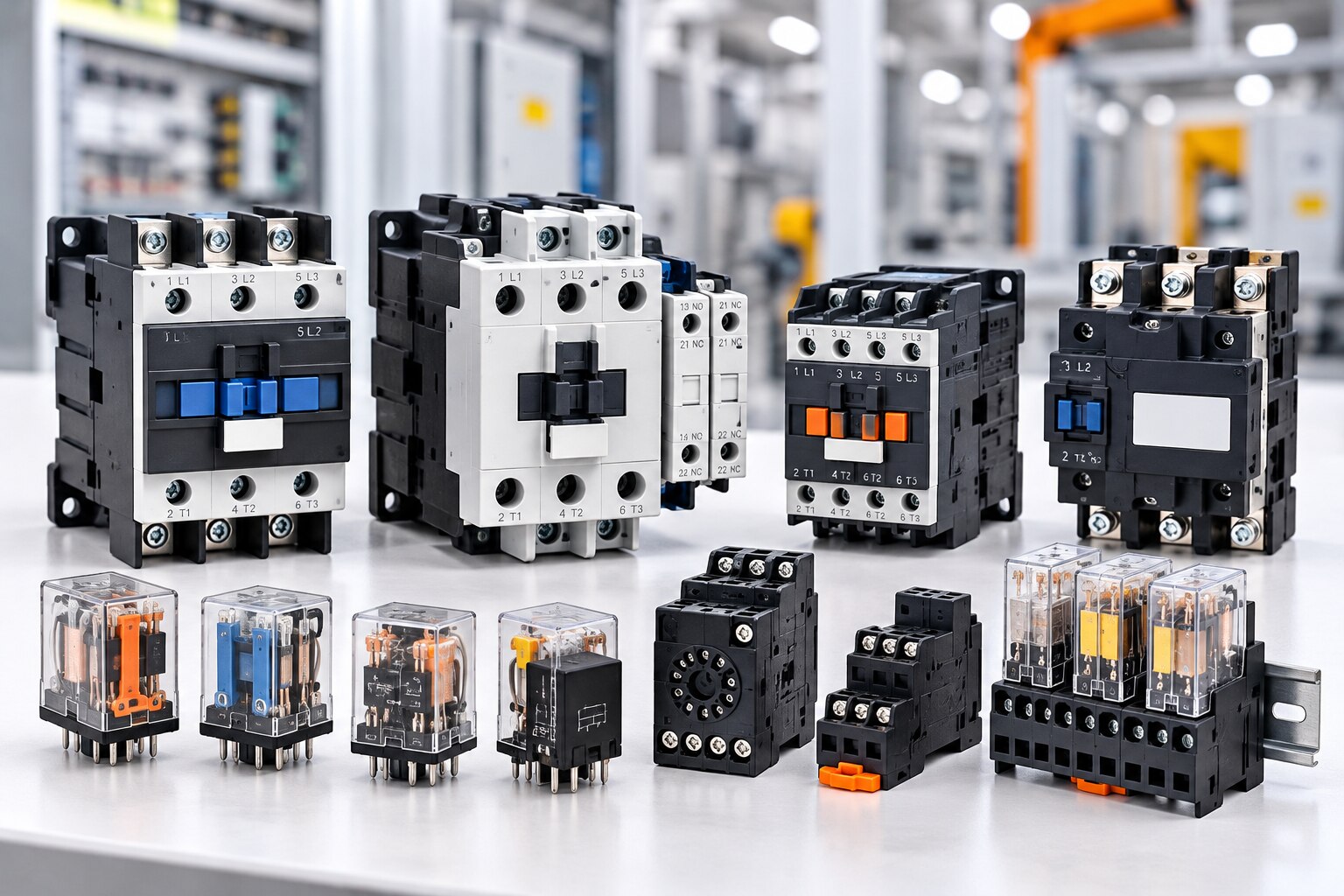
A relay that carries a control signal is not automatically suitable for a motor, heater, compressor, valve, or lamp circuit. By separating device type, coil, utilisation category, load behaviour, protection, and procurement evidence, you can specify an assembly that works in the panel and remains traceable through production.
Key takeaways
- Use relays for signal and interface duties; use contactors for motors, heaters, and compressors.
- Match coil voltage and control type to the PLC output, transformer, and circuit.
- Compare utilization categories, load type, duty cycle, and ratings—not only amperes.
- Put exact part numbers, certificates, packaging, and delivery terms in the OEM RFQ.
Relay or contactor: which device belongs in your circuit?
A relay suits signal switching, PLC interfaces, interposing duties, and lower-power loads; a contactor belongs on motors, compressors, heaters, and other higher-current power circuits. Decide this before comparing brands or prices.
| Device | Standard and duty | Choose it for |
|---|---|---|
| Electromechanical relay | IEC 61810; signal or lower-power AC/DC switching | PLC outputs, interposing, control logic |
| Contactor | IEC 60947-4-1; power switching by utilisation category | AC-1 non- or lightly inductive loads; AC-3 squirrel-cage motor starting and normal switching; AC-4 plugging, inching, or jogging |
| Specialised device | Application-specific construction | Safety circuits, timing, latching, solid-state, or reversing control |
For a relay, specify SPDT or DPDT contacts, normally open or normally closed poles, contact material, switching voltage and current for the actual AC or DC load, minimum load, contact resistance, electrical life, and mechanical life. A stated 10 A resistive rating does not prove suitability for a DC solenoid or motor.
Choose a safety relay for monitored emergency stops and guards, a timer relay for delayed operation, an interface relay for PLC isolation or level conversion, and a latching relay when the state must remain without coil power.
Choose a solid-state relay for quiet, frequent switching after checking leakage and heat; choose a reversing contactor assembly for forward/reverse motors with electrical and mechanical interlocking.
A motor contactor is not complete protection. The starter also needs short-circuit protection and a correctly selected overload relay. Ask any contactor supplier in Delhi for the complete coordination arrangement, not only a headline ampere figure.
Match the coil to the PLC, transformer, and output circuit
Choose the coil by matching the control source, not by nominal voltage alone.
| Coil option | Match it to | Check before ordering |
|---|---|---|
| 12 VDC | 12 VDC power supply or transistor output | Polarity, permissible voltage tolerance, pickup and dropout voltage, coil current |
| 24 VDC | PLC output, 24 VDC supply, or interface relay | Available current, inrush, suppression, and voltage drop |
| 110 VAC | 110 VAC control transformer or AC output | 50/60 Hz frequency, tolerance, leakage, and minimum load |
| 230 VAC | 230 VAC control circuit | Frequency, insulation, touch protection, transformer capacity, and pickup margin |
An AC coil cannot replace a DC coil. A relay output, transistor output, and triac output also differ in polarity, leakage, inrush, and minimum-load requirements; verify the output’s current against the coil’s pickup demand.
A diode suits a DC coil; an RC network, varistor, or dedicated suppressor suits the specified circuit. Suppression reduces voltage transients but can increase dropout time, causing delayed contactor release. After fitting it, test PLC timing, safety-controller timing, contactor chatter, and output stress.
Specify auxiliary contacts as normally open or normally closed. Use mirror or positively linked contacts when a safety function requires that property. Reversing assemblies need both electrical and mechanical interlocking, plus arc suppression or surge suppressors. This control-side specification helps you buy industrial relays in Delhi without ordering by voltage alone.
Read the rating tables instead of matching a nominal ampere figure
A 10 A resistive rating does not prove that a relay can switch a 10 A motor, solenoid, lamp, or DC-inductive load. DC has no AC current zero crossing to help extinguish the arc, so contact interruption is harder.
1. Identify the exact load. For a contactor, read rated operational current Ie with the utilisation category: AC-1 for resistive or lightly inductive loads, AC-3 for squirrel-cage motor starting and normal switching, and AC-4 for plugging, inching, or jogging.
Check rated insulation voltage Ui, rated impulse withstand voltage Uimp, short-circuit protection, and the manufacturer’s load curves.
2. Separate relay ratings by resistive, inductive, lamp, solenoid, valve, motor, AC, and DC duty. Ask for motor starting current, heater or lamp inrush, switching frequency, duty cycle, and the manufacturer’s derating tables.
3. Check the installation conditions for industrial control components in Delhi, not just the nominal room temperature. Record ambient and enclosure temperature, ventilation, altitude, condensation, dust, vibration, terminal temperature rise, and the simultaneous energised load. Use the manufacturer’s exact altitude and temperature limits; a rating in open air can fall inside a crowded cabinet.
4. Match each risk to a specification. Undersizing can weld contacts; excessive inrush can cause nuisance trips, overheating, and premature wear. Require Type 1 or Type 2 coordination data where applicable, and confirm prospective fault current stays below the declared assembly rating.
The utilisation category, load curve, duty cycle, and environmental derating table decide suitability—not nominal current alone.
Choose switching technology and protection for the real duty
A machine that switches a small signal, a heater, and a motor does not need the same switching technology. Choose against load type, switching frequency, fault behaviour, and required release time.
| Option | Strength | Main limitation | Use when |
|---|---|---|---|
| Electromechanical relay | Near-zero off-state leakage, galvanic isolation | Audible noise, bounce, wear, finite electrical life | Signals, PLC interfaces, and low-power loads |
| Solid-state relay | Quiet, fast, no contact wear | Leakage, forward voltage drop, heat, defined failure response | Frequent switching of compatible AC or DC loads |
| Safety relay | Monitored architecture and safety-rated contacts | Must match the safety circuit and reset method | Emergency stops, guards, and two-channel functions |
| Timer relay | Repeatable delay or pulse | Timing accuracy and reset behaviour constrain use | On-delay, off-delay, and sequencing |
| Interface relay | Electrical separation and signal conversion | Adds contacts, wiring, and another failure point | PLC-to-contactor or voltage-level interfacing |
| Latching relay | Holds state without continuous coil power | Requires reliable set/reset control | Battery-backed or low-energy controls |
| Motor contactor | Suited to motor current and utilisation categories | Needs separate protection and interlocking | Motors, compressors, heaters, and reversing assemblies |
For a solid-state relay, verify AC or DC compatibility, zero-cross or random-turn-on operation, minimum load, inrush tolerance, heat-sink size, and thermal calculation. For a DC inductive load, select a diode, RC network, varistor, or other suppressor against switching speed and release time.
Combine motor contactors with overload and short-circuit protection. For safety functions, confirm positive-guided or mirror-contact behaviour. If a relay output drives a coil, calculate output inrush and confirm suppression does not delay dropout or overload the PLC output.
Build an OEM RFQ that protects traceability and landed cost
Send an RFQ that identifies the exact device, not merely “24 V relay” or “40 A contactor.” State the manufacturer ordering code, coil voltage and frequency, pole count, NO and NC arrangement, utilisation category, Ie, Ui, Uimp, auxiliary-contact configuration, overload-relay compatibility, short-circuit coordination requirement, enclosure conditions such as ambient temperature and IP rating, quantity, and expected switching duty.
Ask an industrial relays and contactors supplier in Delhi or a relay distributor for OEM to provide:
- Current datasheet and catalog revision
- Conformity information and applicable test or coordination tables
- Country of origin, batch or date code, and packaging details
- Traceable commercial invoice with manufacturer ordering code
- Separate ex-stock, factory, and indent/import lead times
- Freight, taxes, customs-related charges, documentation, and replacement handling
Treat authorized-channel status or documented traceability as more valuable than a low unit price for production-critical parts. A broad family description or product photograph cannot prove identical coil, contact, endurance, or fault characteristics.
Incoming inspection can verify manufacturer marking, exact ordering code, date or lot code, packaging integrity, coil resistance, contact continuity, and the mechanical drawing. These checks do not replace functional or endurance testing.
MAXGTECH can help a Delhi OEM compare sourced relays, contactors, overload protection, and imported control components against application data and traceability documents rather than price alone.
Frequently asked questions
Should you use a relay or a contactor for an OEM circuit?
Use a relay for signal switching, PLC interfaces, interposing duties, and lower-power loads. Use a contactor for motors, compressors, heaters, and other higher-current power circuits.
How do you match a relay or contactor coil to a control circuit?
Check the coil voltage, AC or DC type, pickup and holding requirements, PLC output capacity, transformer rating, and the circuit’s available voltage.
Why should you read the full rating table instead of matching amperes?
Check the load type, utilization category, motor starting current, resistive or inductive duty, switching frequency, duty cycle, poles, and temperature conditions alongside the nominal current.
What should an OEM include in an RFQ for industrial relays and contactors?
Specify the exact part number, coil and contact ratings, utilization category, required accessories, approved substitutes, traceability documents, packaging, delivery terms, and landed-cost requirements.
Keywords