Industrial electronic systems rarely operate from a single voltage rail. Control boards, sensors, communication modules, processors, relays, and other subsystems may each require different voltage levels.
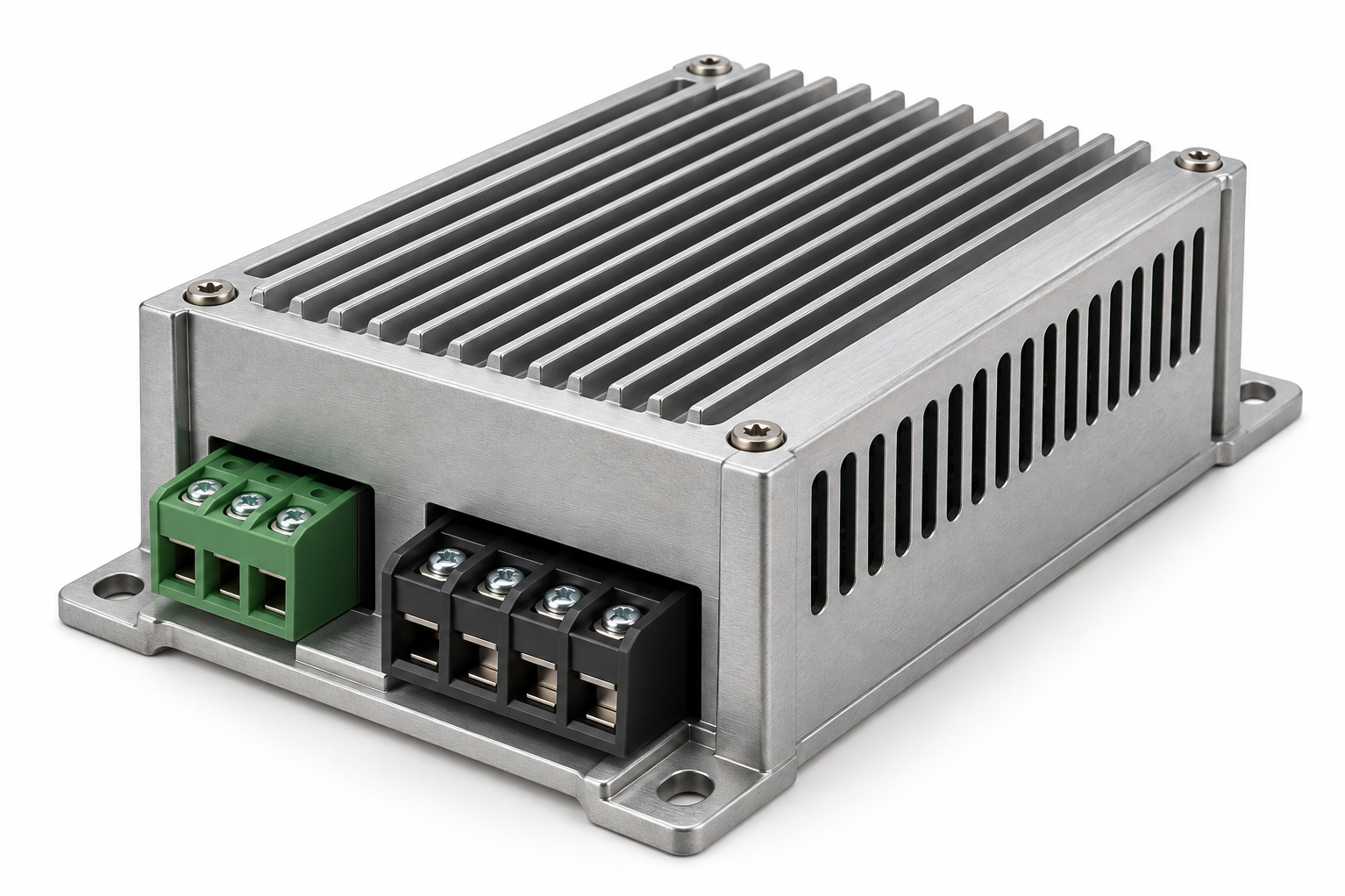
A DC-DC converter provides the necessary voltage conversion, but selecting an Industrial DC-DC Converter Supplier involves more than matching input and output voltage. Efficiency, isolation, load behaviour, thermal performance, electrical noise, protection, and environmental conditions all influence suitability.
Define the Input Voltage Range
Industrial power sources are not always perfectly stable.
A system described as operating from a nominal DC supply may experience normal variation or transient conditions. The converter's permitted input range should accommodate expected operating conditions with an appropriate engineering margin.
For battery-powered systems, the voltage can also change substantially between charged and discharged states.
Confirm Output Requirements
Engineers should define the required output voltage and maximum load current.
If multiple rails are required, determine whether separate converters or a multi-output solution is more appropriate.
The converter should also maintain acceptable output regulation as input voltage and load conditions change.
Isolated and Non-Isolated Converters Serve Different Needs
Isolation can be important where two circuit sections need galvanic separation for safety, noise control, grounding, or system architecture.
Non-isolated converters may offer advantages in applications where isolation is unnecessary.
The choice should be made according to the circuit rather than assuming isolation is always preferable.
Efficiency Influences Thermal Design
A converter is never perfectly efficient. The difference between input power and output power becomes heat.
Even a small efficiency difference can become significant in compact or enclosed equipment operating continuously.
Engineers should review efficiency under realistic load conditions because peak efficiency may occur only within a particular part of the load range.
Electrical Noise Requires Attention
Switching converters can generate conducted and radiated electrical noise.
In systems containing sensitive analogue circuits, communication equipment, instrumentation, or sensors, this can influence overall performance.
PCB layout, grounding, filtering, shielding, switching frequency, and converter characteristics all contribute to electromagnetic compatibility.
Protection Features Can Add Robustness
Depending on the converter, useful protection functions may include:
- Overcurrent protection
- Short-circuit protection
- Overvoltage protection
- Thermal shutdown
- Undervoltage lockout
The required protection strategy depends on the equipment and should be evaluated alongside external circuit protection.
Industrial Conditions Change the Buying Decision
Converters used in industrial machinery may experience temperature variations, vibration, electrical disturbances, and long operating cycles.
Delhi and surrounding NCR manufacturing businesses sourcing converters for industrial applications should therefore consider environmental specifications rather than choosing components designed only for controlled indoor electronics.
MAXGTECH serves B2B electronic component requirements in Delhi across multiple industrial electronics categories. Buyers evaluating DC-DC converter requirements should provide complete input, output, power, isolation, package, temperature, and quantity information to make supplier discussions more productive.
Calculate Value Over the Equipment Lifecycle
The lowest-cost converter is not necessarily the most economical choice.
A useful evaluation considers efficiency losses, thermal requirements, expected operating hours, replacement difficulty, engineering qualification, and potential downtime.
For an OEM manufacturing hundreds of units, even small differences in efficiency or reliability can influence lifecycle costs.
Choosing an Industrial DC-DC Converter Supplier should therefore combine technical qualification with commercial and supply-chain evaluation.
A well-selected converter provides stable power to the downstream electronics while fitting the thermal, electrical, mechanical, and environmental requirements of the system. When procurement decisions begin with these requirements, buyers can avoid many of the compatibility problems that otherwise appear during testing or production.