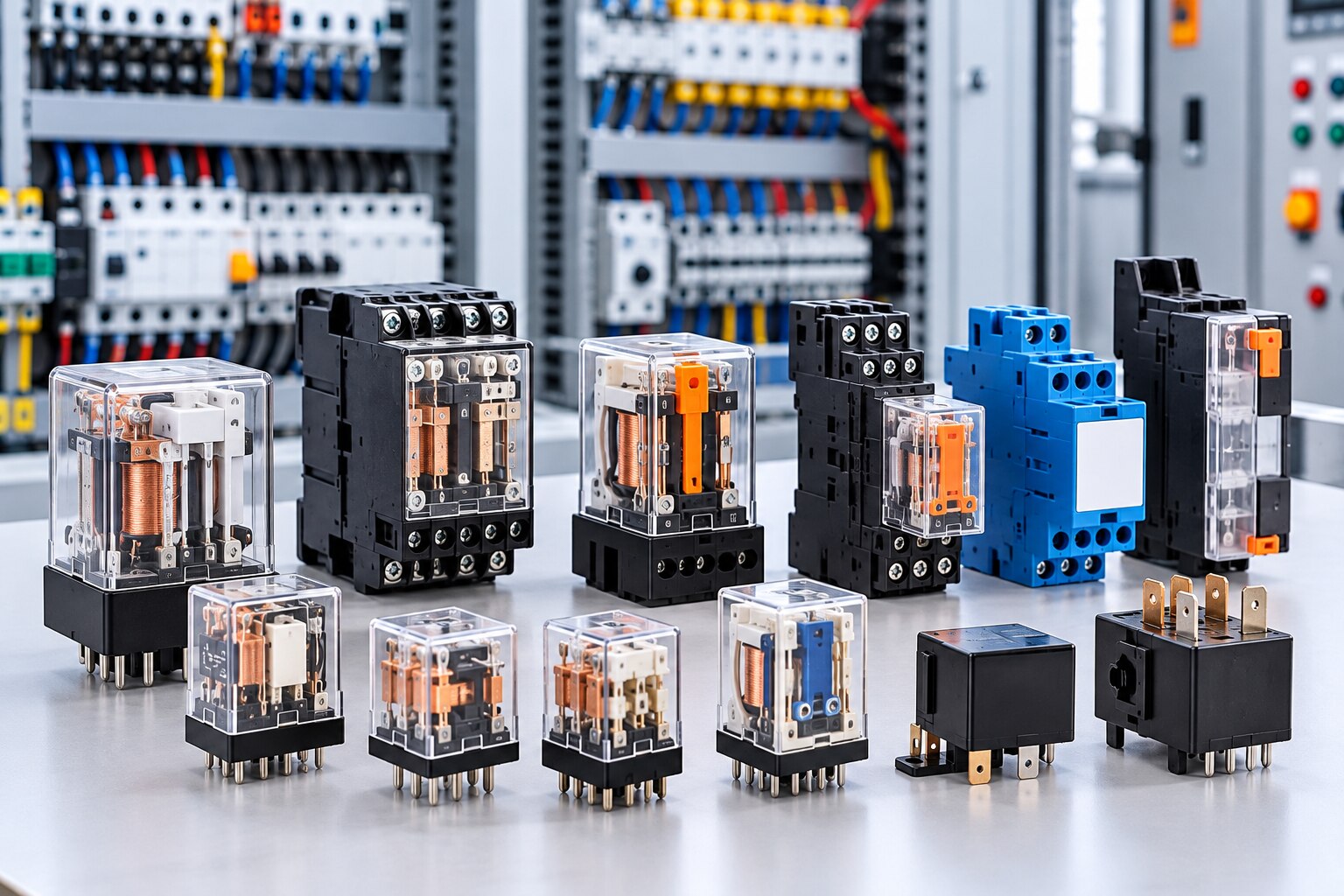
A relay supplier must prove more than catalogue availability: the device must match your load, coil circuit, control-panel environment, documentation requirements, and delivery risk. By the end, you will have a practical method for comparing suppliers, qualifying samples, and building a quotation that does not hide technical exceptions or substitution risks.
Key takeaways
- Select relays from load type, inrush current, switching duty, and control voltage.
- Match contact ratings to motor, solenoid, valve, transformer, and lamp loads.
- Request datasheets, batch traceability, stock evidence, and sample approval records.
- Compare delivery, substitutions, quality checks, and escalation support—not unit price alone.
Start with the Load, Control Function, and Device Category
Choose the switching device from the load and control function, not from the largest current printed in a catalogue. A motor, solenoid, valve, transformer, or lamp creates inrush or turn-off stress that a resistive rating does not represent.
Identify AC or DC, inrush current, switching frequency, isolation needs, and whether the circuit requires fail-safe operation or safety monitoring.
| Option | What it switches | Choose it when |
|---|---|---|
| Electromechanical relay | Isolated control or light power circuits; SPDT and DPDT contacts | You need flexible contact arrangements, galvanic isolation, or infrequent switching |
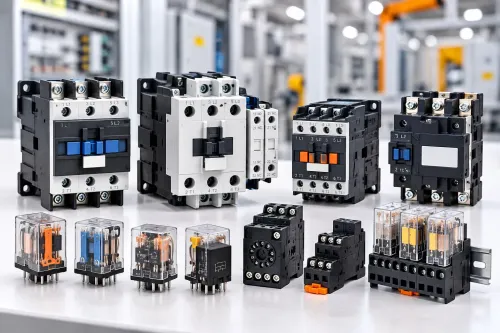
| Contactor or motor starter | Power circuits feeding motors and other substantial loads | You need motor switching, overload coordination, and IEC 60947-4-1 equipment; ask a contactor supplier in Delhi |
| Solid-state relay | AC or DC loads without mechanical contacts | You need silent, frequent switching and accept leakage current, heat, and failure-mode trade-offs |
| PLC output module | Controller-connected control outputs | The PLC’s voltage, current, isolation, and diagnostic limits match the load; add an interposing relay when they do not |
A relay supplier in Delhi for industrial control systems should provide the relevant utilization category and load test condition, not just a nominal ampere figure. IEC 61810-1 covers general-purpose relay requirements; IEC 60947-5-1 covers control-circuit devices.
For a safety function, define redundancy, contact monitoring, diagnostic coverage, and the required performance level or SIL before selecting hardware. “Industrial grade” is not a safety rating. A small interface relay is not a substitute for a motor contactor because its current number looks similar.
Check Relay Specifications Against the Real Control Circuit
A 24 V DC coil does not prove that a relay suits your circuit. Match the coil’s voltage tolerance, resistance, pickup and release times, contact form, AC or DC load, inrush current, switching frequency, and electrical life to the actual duty.
Ask for load-specific ratings, including utilization categories such as AC-15 or DC-13 under IEC 60947-5-1, rather than relying on a resistive-current figure.
- Identify whether the load is a motor, solenoid, valve, transformer, lamp, heater, or resistor; each creates different inrush or turn-off stress.
- Use an IEC 60947-4-1 contactor or motor-starter for power-circuit switching; do not replace it with a small interface relay because the nominal current looks similar.
- Request the internal coil suppression type. A diode requires correct polarity and can delay release, while an LED, resistor, or RC network behaves differently in interlocks and pulse circuits.
- For a safety function, define redundancy, contact monitoring, diagnostic coverage, and the required Performance Level or Safety Integrity Level before accepting a component labelled “industrial grade.”
- Check mounting orientation, terminal access, vibration, shock, ambient temperature, humidity, condensation, dust, enclosure conditions, and derating limits. An IP rating for the relay body does not describe the whole panel environment.
Ask an industrial relay supplier in Delhi for a representative sample, then verify markings, packaging, pinout, coil resistance, insulation resistance or dielectric strength, and operation at the intended duty cycle. Switch the real load, not a continuity tester’s small test current. Continuity cannot prove contact endurance, insulation coordination, or authenticity.
Qualify the Supplier’s Engineering, Stock, and Traceability Capability
A search for “control relay distributor india” is not proof of industrial capability. Ask for the manufacturer’s exact part number, revision or date code, country of origin, batch or lot traceability, and documented authorized supply route. “24 V, 10 A ice-cube relay” is inadequate because contact material, socket, coil suppression, and approvals can change.
Require evidence that the supplier can manage these points:
- A datasheet covering your actual motor, solenoid, valve, transformer, or lamp load, including utilization category and inrush or turn-off limits—not only a resistive-current rating.
- Stock records showing available quantities, factory condition, date-code policy, and replenishment lead time.
- A written obsolescence and substitution process requiring engineering approval before a mechanically pin-compatible alternate ships.
- Coil details identifying any LED, diode, resistor, or RC suppressor, plus polarity and release-time data.
- Application support that distinguishes IEC 60947-5-1 control-circuit devices from IEC 60947-4-1 contactors and motor-starters.
For a safety-related function, reject “industrial grade” as a safety claim. The supplier must work from your required architecture, redundancy, contact monitoring, diagnostic coverage, and performance or integrity level; the component alone does not establish compliance.
A capable supplier also documents escalation: named technical contacts, failure-analysis support, corrective-action reports, and change notifications. Those records show whether you are buying a controlled supply channel or merely receiving whatever relay matches a catalogue description.
Compare Commercial Offers by Total Sourcing Risk
Compare each offer by delivered risk, not unit price: a cheap relay with an uncertain substitute, vague stock status, or an uncommitted dispatch date can cost more than a higher-priced, traceable part. For electrical relay sourcing, price the complete compatibility set: relay, socket, retaining clip, test button, LED module, and suppression module.
| Offer element | Low-risk evidence | Red flag |
|---|---|---|
| Quotation | Exact manufacturer part number, revision, origin, batch traceability, and separate accessory prices | “24 V, 10 A ice-cube relay” with no contact material or socket number |
| Lead time | Quantity available, warehouse location, allocation status, and a dated dispatch commitment | “Available soon” or stock shown without quantity |
| Substitution | Written obsolescence process and engineering approval before any alternate | “Equivalent” accepted without comparing coil, contacts, timing, creepage, and approvals |
| Delivery | Incoterm, carrier responsibility, promised arrival date, and escalation contact | Delivery date that excludes inspection, customs, or shortage risk |
Ask each supplier to confirm these points in the quotation:
- Approve one complete relay-and-socket part-number combination; similar pin counts do not prove compatible pin numbering or accessory interfaces.
- Request the internal coil suppression type and release-time data. A diode, resistor, LED, or RC network changes polarity, release behaviour, or both.
- Reject automatic substitutions. A mechanically compatible relay can change minimum-load performance, contact material, ratings, or approvals.
- Separate control relays from IEC 60947-4-1 contactors and motor starters; IEC 60947-5-1 control devices are not power-switching substitutes.
- Require written notification of shortages, revised delivery dates, and the person who will resolve them.
Approve Samples and Build a Supplier Relationship You Can Escalate
A sample passes only when the complete relay-and-socket combination survives your actual control-panel test. A relay supplier in Delhi for industrial control systems must prove performance under the real motor, solenoid, valve, transformer, or lamp load—not just a resistive 10 A rating.
1. Test coil pickup, dropout, voltage tolerance, contact heating, switching noise, and dielectric isolation at the panel’s minimum and maximum supply voltage. Record inrush current and turn-off stress; an interface relay is not a substitute for an IEC 60947-4-1 contactor or motor starter.
2. Approve the exact relay, socket, retaining clip, test button, LED, and suppression module part numbers together. Check pin numbering, contact form, coil voltage, accessory fit, manufacturer part number, revision or date code, country of origin, and batch traceability.
3. If the relay serves an emergency stop, guard, or other safety function, document the required architecture, redundancy, contact monitoring, diagnostic coverage, and performance or integrity level before approval. “Industrial grade” proves none of these.
An industrial relay supplier in Delhi should support a controlled approved-parts list, lot records, forecast reviews, and written notification before any substitution. A control relay distributor India can add value by holding agreed stock, supplying inspection reports, and escalating failures to the manufacturer instead of replacing parts silently.
MAXGTECH can support this process by coordinating technical sourcing, documentation, and replacement investigation across repeat control-panel orders. Keep a failure log with panel location, load, batch, socket, wiring, and operating conditions; that evidence turns a recurring fault into an actionable supplier escalation.
Frequently asked questions
How do you choose a relay for an industrial control system?
Start with the load and control function. Identify whether the relay switches a motor, solenoid, valve, transformer, lamp, heater, or resistive load, then check inrush current, turn-off stress, switching frequency, coil voltage, contact configuration, and duty cycle.
Which relay specifications should you verify against the control circuit?
Verify coil voltage and power, contact arrangement, resistive and inductive load ratings, inrush rating, maximum switching voltage, electrical life, insulation rating, operating temperature, mounting method, and terminal arrangement.
How should you qualify an industrial relay supplier in Delhi?
Ask for manufacturer authorisation or supply records, current datasheets, batch or lot traceability, stock location, lead time, inspection procedures, counterfeit controls, sample availability, and an escalation contact for technical and delivery issues.
How should you compare relay supplier quotations?
Compare the approved part number, genuine manufacturer, minimum order quantity, lead time, warranty, inspection cost, freight, taxes, substitution terms, documentation, and the cost of line stoppage if delivery or quality fails.
Why approve relay samples before placing a production order?
Samples let you confirm coil operation, contact configuration, terminal fit, mechanical dimensions, load performance, markings, packaging, and documentation before the relay enters a control-panel build.
Keywords