An LED chosen by colour alone can fail through poor contrast, excessive current, heat, vibration, or an unsuitable enclosure. By the end, you will be able to match each display or equipment function to the right LED format, drive circuit, environmental rating, and purchasing specification for conditions in Delhi.
Key takeaways
- Match LED colour to the machine state and the operator’s required response.
- Specify forward current, viewing angle, brightness, and drive circuit together.
- Use panel indicators, seven-segment displays, or dot-matrix LEDs for the right function.
- Check temperature, humidity, dust, vibration, and supplier traceability before production.
Where LEDs serve machines, panels, and industrial instruments
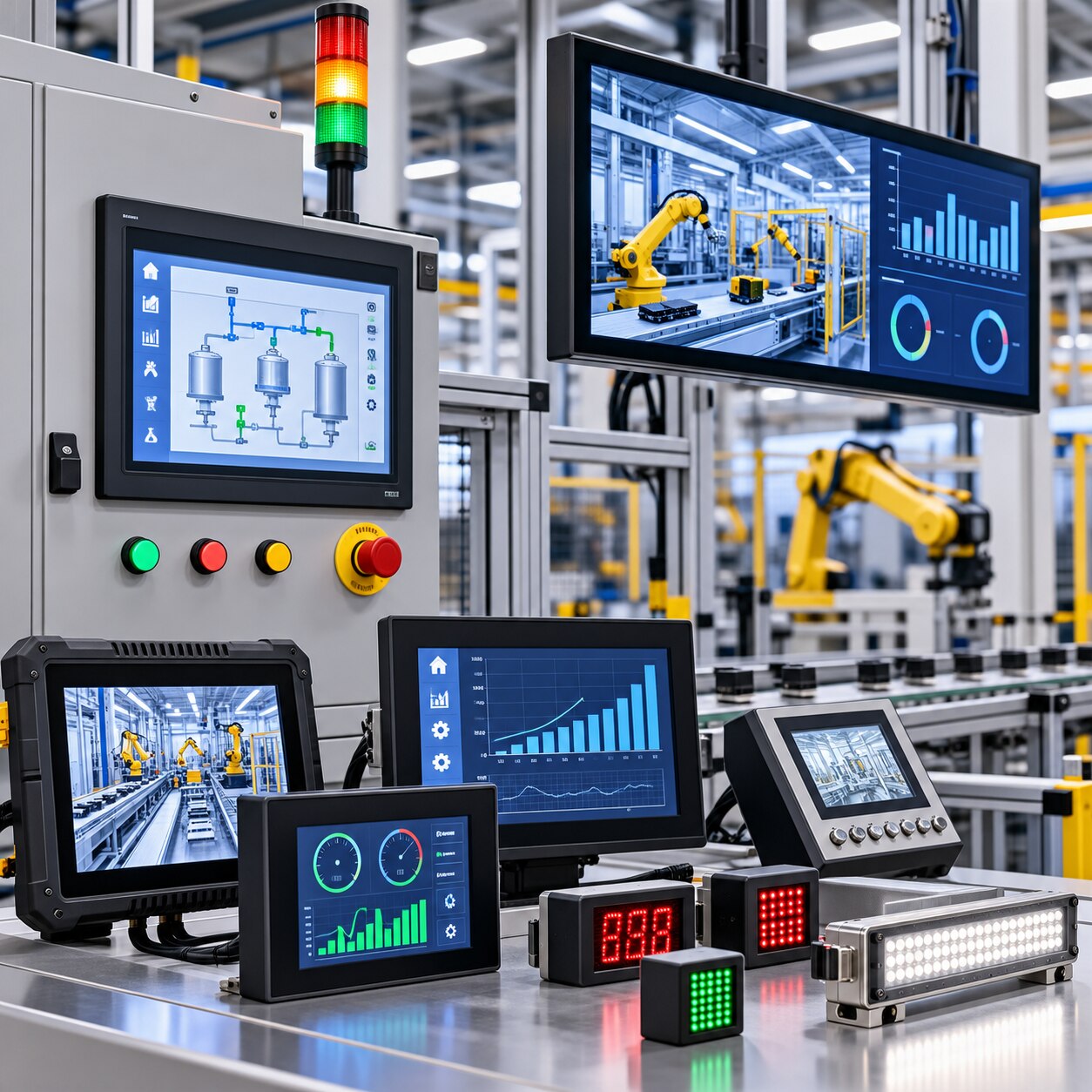
LEDs convert machine conditions into visible information: green for ready or running, amber for warning, red for fault, and blue for a selected function. The main LED applications for industrial displays and equipment in Delhi include:
- Machine-status indication for power, cycle, run, and communication states
- Alarm annunciation for trips, faults, and unsafe conditions
- Push-button and selector-switch illumination
- Seven-segment numeric displays for counts, timers, and measured values
- Dot-matrix displays for messages and codes
- Bar graphs for level, speed, temperature, or load
- Operator panels and human-machine interfaces
- Control-cabinet indicators and panel meters
- Instrument backlighting for scales, gauges, and liquid-crystal displays
- Keypad illumination on industrial terminals
- Infrared transmission in sensing and remote-control circuits
- Optical sensing in encoders, counters, and detection systems
- Isolation-feedback circuits in power supplies and control electronics
LEDs for machine displays do more than emit light. They must remain legible through a lens, diffuser, or smoked window while matching the PLC output and the available supply.
A 5 mm red LED is not a complete purchasing specification. Record luminous intensity in millicandelas for point indicators, or luminance and viewing angle for panels and backlights, alongside forward current, colour bin, junction-temperature limit, lifetime test method, and humidity or corrosion requirements.
For sunlight-exposed equipment, test the assembled display. Reflections, cover losses, contrast, and viewing angle can defeat a bright bare LED.
How colour, brightness, wiring, and drive circuits determine a usable indication
A reliable indication starts by matching the LED interface to the controller, not by ordering a nominal “5 mm red LED.” For a 24 VDC PLC output, calculate the series resistor from the highest supply voltage, the LED forward voltage, and the target current; check resistor power and the PLC output’s minimum load.
Confirm polarity, forward-current range, and reverse-voltage limit before approval.
Specify these fields on the drawing or purchase order:
- Colour bin or chromaticity, not just colour name
- Luminous intensity in millicandelas for an indicator, or luminance in candelas per square metre for a display
- Viewing angle and required visibility at the operator’s distance
- Forward voltage at the stated current, maximum continuous current, and junction-temperature limit
- Common-anode, common-cathode, or independent wiring, including connector pinout
- Resistor drive, constant-current drive, or PWM control; for PWM, state frequency and minimum duty cycle
- Humidity, corrosion, lifetime test method, and exact model revision
A resistor suits a fixed-voltage lamp. Multiplexed displays, wide supply ranges, and high-brightness backlights need regulated current or controlled PWM, because uncontrolled peaks cause uneven brightness and shortened life. Low-frequency PWM can flicker to cameras even when it looks steady to you.
LED applications in electronic products also demand final-assembly testing: switching drivers can create conducted or radiated emissions, so test the wired unit in its enclosure against IEC 61000-4 immunity and IEC 61000-6 emissions requirements. Apply IEC 60073 coding principles, and pair colour with a symbol, position, text, or sound rather than relying on colour alone.
Choosing the right LED format for the display function
Choose the format by the job at the operator’s eye: a bare LED suits a circuit board, while a complete pilot-light assembly suits a specified panel hole, lens, terminal arrangement, and maintenance process.
| Option | What it means | When it applies |
|---|---|---|
| Bare LED | An exposed two-lead or surface-mount package with no bezel, lens, or wiring | PCB indicators, backlights, sensing, and compact electronic products |
| Indicator | A bare LED installed in a holder or small panel body, often with leads or terminals | Status, alarm, power, and communication indications |
| Light pipe | A clear optical guide that carries LED light from a hidden PCB to the panel surface | Thin operator panels where the LED cannot sit behind the viewing point |
| Panel lamp | A panel-mounted lamp with a bezel, lens, and connection method | Cabinet doors, panel meters, and illuminated controls |
| Numeric display | A multi-segment or dot-matrix module that forms digits, letters, or symbols | Counters, temperatures, setpoints, and machine readouts |
| Complete pilot-light assembly | A fully specified assembly including body, lens, terminals, mounting hardware, and often sealing | Repeated field replacement, 24 VDC controls, and rugged machine panels |
LEDs for machine displays need more than the right colour. Match the assembly’s viewing angle, brightness, and mounting depth; compare small indicators by millicandelas, but compare large displays by luminance and uniformity.
For LED applications in electronic products, check the driver as well as the die. Fast PWM edges and switching regulators can create emissions, so test the finished wiring and enclosure against the applicable IEC 61000-4 immunity and IEC 61000-6 emissions requirements.
How Delhi operating conditions change LED selection
Delhi’s heat, dust, monsoon moisture, and electrically noisy machinery change the specification for led applications for industrial displays and equipment in delhi. Choose the LED and assembly for its installation, not merely its colour or package diameter.
| Environment | Selection factors | Failure if missed |
|---|---|---|
| Indoor control panel | Junction-temperature margin, luminance, viewing angle, colour bin, EMC immunity, and 24 VDC driver compatibility | A hot cabinet, narrow viewing angle, or conducted noise makes a correct status signal unreadable |
| Factory floor | IEC 60068 vibration, shock, temperature cycling, solder-joint strength, lens retention, and resistance to oil or cleaning chemicals | Repeated machine starts loosen connectors or create intermittent indications |
| Outdoor equipment | IEC 60529 enclosure IP rating, solar-readable luminance, UV stability, humidity and corrosion resistance, cable-entry sealing, and surge protection | Water enters through a gland even though the exposed LED package appears sealed |
| Mobile device | Low forward current, battery-efficient PWM control, shock resistance, optical uniformity, and compact thermal paths | Brightness drains the battery or a drop cracks the display assembly |
Specify luminous intensity or luminance, viewing angle, forward-current range, maximum junction temperature, colour bin, and lifetime test method. High brightness depends on PCB copper, thermal vias, pad design, enclosure temperature, and driver efficiency; a higher-current replacement is not automatically equivalent.
For leds for industrial equipment, qualify the complete assembly under IEC 60068 tests, not only the semiconductor. Record the exact model and revision, then check Indian restricted-substance and e-waste obligations; a generic RoHS declaration does not cover finished equipment.
How to qualify an industrial LED component and supplier before production
Do not approve a sample because it lights. Approve a defined part, assembly, supplier, and test result that match the production design.
1. Record the manufacturer part number, exact model and revision, colour bin, viewing angle, forward-voltage and current range, maximum junction temperature, lifetime test method, PCB revision, and approved substitute rules. “5 mm red LED” is not a purchasing specification.
2. Request the datasheet, drawing, bill of materials, lot or date code, country of origin, change-notification process, and certificate of conformity. For imported electronic products, check the applicable Indian restricted-substance and e-waste producer-responsibility obligations. Tie every declaration to the finished model and revision; a component RoHS statement does not automatically cover the equipment.
3. Test samples electrically and optically at the intended drive current and temperature. Measure forward voltage, current, luminous intensity or luminance, colour or bin consistency, viewing angle, polarity, dimming response, and 24 VDC interface behaviour.
4. Test the complete assembly in its final wiring and enclosure for conducted and radiated emissions, plus applicable IEC 61000-4 immunity tests. Fast PWM edges and switching regulators can create failures that the LED datasheet will not reveal.
5. Run assembly-level temperature cycling, vibration, shock, damp-heat, and start-stop testing under the equipment duty cycle. For outdoor or wash-down equipment, verify the complete enclosure’s IEC 60529 IP rating, including cable entries.
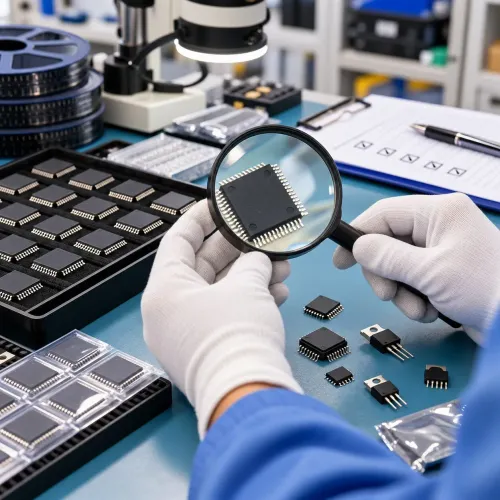
6. Qualify an industrial LED components supplier in Delhi through traceability, counterfeit screening, reel and moisture-control checks, and sample inspection. Give MAXGTECH the same acceptance sheet if it is helping source parts for your LED applications in electronic products.
Frequently asked questions
Where are LEDs used in industrial displays and equipment?
LEDs indicate machine states on control panels, operator interfaces, instruments, alarms, push buttons, status modules, and numeric or graphic displays.
How do colour and brightness affect an industrial LED indication?
Assign colours to clear machine states, then select brightness and viewing angle for the panel distance, ambient light, and operator position.
Which LED format suits a machine display?
Use discrete LEDs for individual status points, panel indicators for rugged front-panel signalling, seven-segment displays for numbers, and dot-matrix or graphic modules for richer information.
What should you check when qualifying an industrial LED supplier in Delhi?
Verify the exact part number, forward-current and voltage data, temperature range, optical specifications, lifecycle documents, lot traceability, samples, and production inspection records.
Keywords