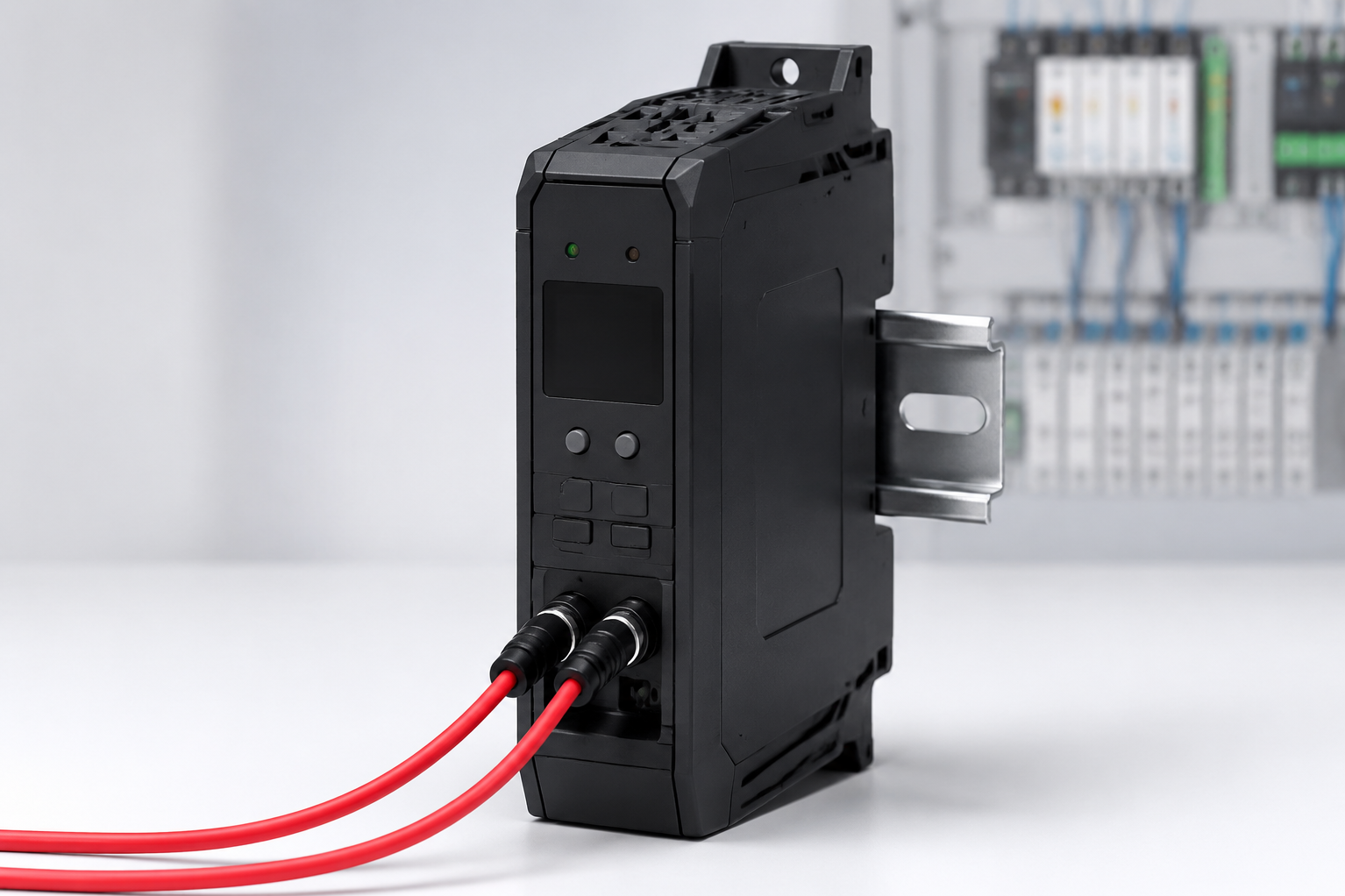
Industrial sensing becomes challenging when objects are extremely small, installation space is limited or conventional sensors cannot be positioned close to the detection point. A fiber optic amplifier combined with suitable fiber optic sensing heads can provide a practical solution for these demanding applications.
For automation engineers and equipment manufacturers in Delhi, understanding where fiber optic sensing offers an advantage can help avoid unnecessarily complex sensor arrangements.
What Is a Fiber Optic Amplifier?
A fiber optic sensing system generally uses an amplifier unit together with fiber optic cables or sensing heads.
The fiber carries light between the amplifier and the detection area. The amplifier processes changes in the received light and produces the required switching output.
One important advantage is that the sensing point can remain compact while the amplifier electronics are positioned separately.
This configuration can be particularly valuable in machines where conventional sensor bodies cannot fit near the target.
Where Are Fiber Optic Sensors Useful?
Fiber optic sensing can be considered for applications involving:
- Small component detection
- Restricted installation spaces
- Precision positioning
- Packaging machinery
- Electronics assembly
- Part counting
- High-speed production processes
- Detection inside machinery
Different fiber arrangements can support through-beam, reflective and specialized detection requirements.
When Should You Consider a Fiber Optic Amplifier?
There are several situations where fiber optic sensing may be worth evaluating.
Limited Mounting Space
A standard proximity or photoelectric sensor may be too large for the available space. Compact fiber heads can sometimes be installed much closer to the target.
Very Small Objects
Applications involving small electronic parts or precision components may require a focused detection area.
Remote Electronics Requirement
Separating the sensing head from the amplifier can be useful where placing complete electronic sensor hardware at the detection point is inconvenient.
Flexible Sensor Positioning
Fiber configurations are available for different mechanical layouts, helping engineers address unusual machine geometries.
What Specifications Should Buyers Compare?
Do not select the amplifier without considering the fiber unit and application together.
Important points include:
- Compatible fiber type
- Detection method
- Response time
- Light source
- Output configuration
- Supply voltage
- Sensitivity adjustment
- Display and setting functions
- Operating environment
The required response speed is particularly relevant for fast production lines where objects pass the detection point rapidly.
Fiber Optic Amplifiers for Automation Applications in Delhi
Delhi NCR has a broad industrial base that includes automation integrators, machine manufacturers, packaging businesses, electronics manufacturers and control system companies.
MAXGTECH supports industrial electronic component requirements in Delhi, including fiber optic amplifiers and sensing solutions used in automation environments.
Before choosing a system, engineers should define the target object, available installation space, required detection accuracy, operating speed and environmental conditions.
Fiber optic sensing is not necessary for every detection task. Standard proximity or photoelectric sensing may be more straightforward in many applications. However, where space, target size or positioning creates a genuine detection challenge, a properly selected fiber optic amplifier and fiber arrangement can provide an effective and flexible sensing solution.