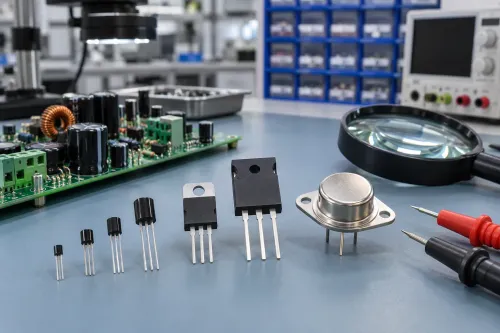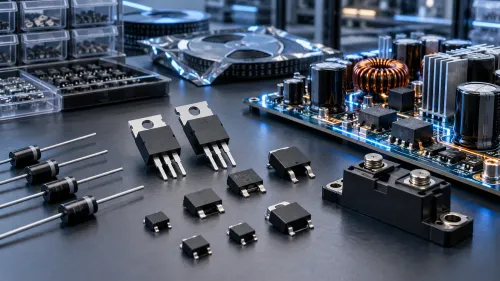
Choosing the right transistor can significantly influence switching performance, amplification, power consumption and overall circuit behaviour. Bipolar Transistors, commonly known as BJTs, and MOSFETs are two widely used transistor technologies, but they operate differently and suit different applications.
For electronics manufacturers, design engineers and industrial buyers in Delhi, the better choice depends on the actual circuit rather than simply selecting the more popular device.
How Does a Bipolar Transistor Work?
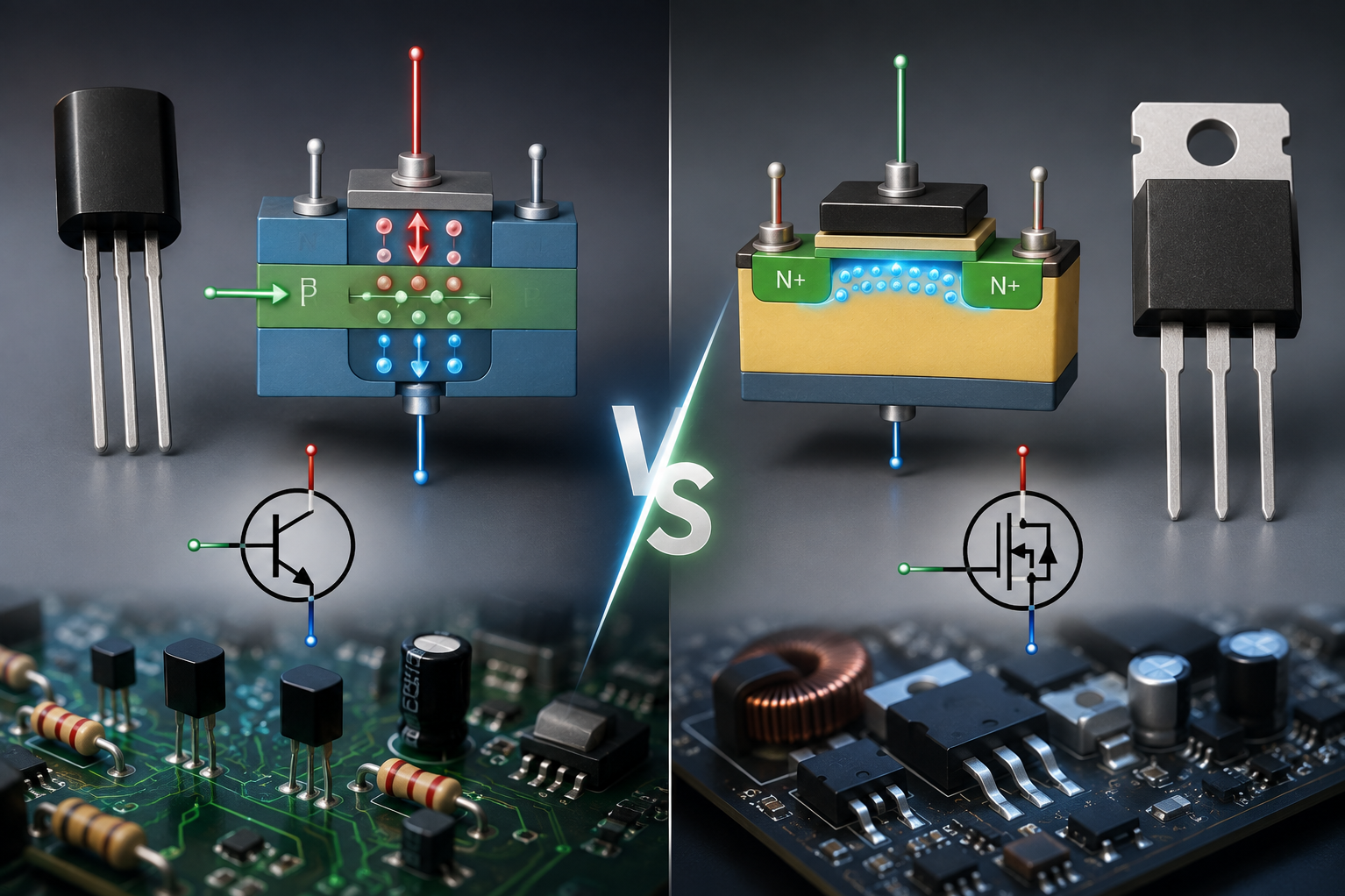
A Bipolar Junction Transistor is a current-controlled semiconductor device. It typically has three terminals: emitter, base and collector.
A relatively small base current controls a larger current flowing between the collector and emitter. BJTs are commonly available as NPN and PNP types.
They are frequently used for:
- Signal amplification
- Electronic switching
- Driver circuits
- Audio circuits
- Control applications
- Current regulation
Their predictable characteristics make them useful in both analogue and switching applications.
How Is a MOSFET Different?
A MOSFET is primarily a voltage-controlled device. Instead of requiring continuous base current like a BJT, its operation is controlled through voltage applied to the gate terminal.
This characteristic can make MOSFETs attractive where efficient switching and low control power are important.
They are commonly found in:
- Power supplies
- Motor control systems
- Power switching circuits
- Battery-powered electronics
- DC-DC converters
- High-frequency switching applications
BJT vs MOSFET: Key Differences
Several factors should be considered when comparing these semiconductor devices.
Control method:
BJTs are current controlled, while MOSFETs are voltage controlled.
Input requirements:
A BJT requires sufficient base current for proper operation. A MOSFET generally requires appropriate gate voltage.
Switching:
MOSFETs are widely used for high-speed and power-switching applications, although the correct choice depends on circuit conditions.
Amplification:
BJTs remain useful in many analogue amplification applications because of their electrical characteristics.
Thermal considerations:
Both devices require appropriate thermal design when operating at significant power levels.
Which Device Should You Select?
Start with the circuit requirements rather than the component category.
Consider:
- Required operating voltage
- Maximum current
- Switching frequency
- Available drive signal
- Power dissipation
- Thermal conditions
- Package requirements
- Amplification or switching purpose
A BJT can be an effective choice where current-controlled operation or analogue amplification is required. A MOSFET may be more suitable where efficient voltage-controlled switching is the priority.
Semiconductor Selection for Delhi Electronics Manufacturers
Delhi and the wider Delhi NCR region have manufacturers and engineering companies working across automation, power electronics, instrumentation, control systems and embedded electronics.
MAXGTECH supports electronic component requirements in Delhi, including Bipolar Transistors - BJT and other semiconductor devices for different circuit applications.
For procurement teams, substituting one transistor for another based only on similar package dimensions can create problems. Voltage, current, gain, switching behaviour, pin configuration and thermal specifications should all be checked.
The best transistor is ultimately the one that matches the electrical and operating requirements of the circuit. Careful comparison at the design and procurement stages helps manufacturers achieve more predictable performance and reduces unnecessary component compatibility issues.