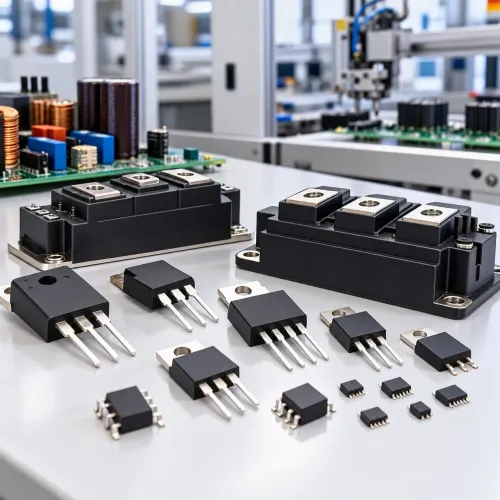
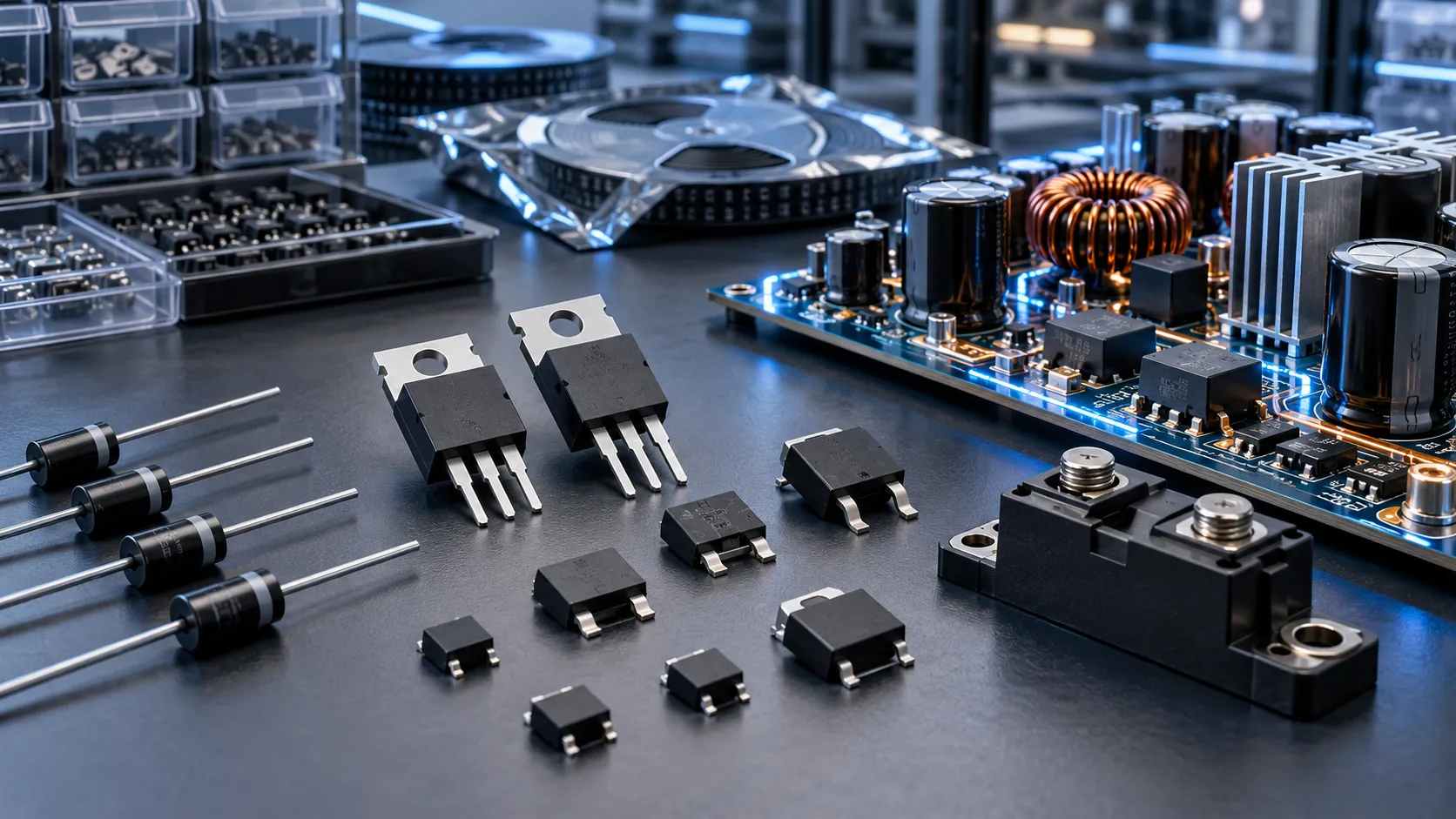
Schottky diodes are widely used where designers need fast switching and relatively low forward voltage drop. These characteristics make them useful in power supplies, converters, protection circuits, high-frequency systems, and various industrial electronic designs.
However, not every Schottky diode is interchangeable. Selecting a Schottky Diode Supplier should begin with the electrical requirements of the circuit and the operating conditions the diode will experience.
Schottky Diodes and Conventional PN Diodes
A conventional silicon PN junction diode and a Schottky diode perform similar basic rectification functions, but their behaviour differs.
Schottky devices generally offer a lower forward voltage drop and fast switching characteristics. These properties can help reduce conduction losses in suitable low-voltage, high-current applications.
Conventional diodes, however, may provide higher reverse-voltage capabilities depending on device type.
This means the choice should be based on circuit requirements rather than assuming one technology is universally better.
Check Reverse Voltage Carefully
One of the first specifications to verify is maximum reverse voltage.
The selected diode needs sufficient margin for the voltage that may appear across it during normal operation and expected transients. Choosing a device too close to the circuit's maximum operating point can reduce design robustness.
Engineers should determine an appropriate design margin based on the application rather than simply matching the nominal supply voltage.
Current Rating Requires Thermal Consideration
A diode's current rating cannot be considered independently from temperature.
As current increases, power dissipation becomes more significant. PCB copper area, airflow, package type, heatsinking, ambient temperature, and duty cycle can all influence thermal performance.
For power electronics, designers should examine datasheet conditions carefully because headline current ratings may be specified under particular thermal conditions.
Leakage Current Can Matter
Schottky diodes can exhibit higher reverse leakage than some conventional diode technologies, and leakage may increase with temperature.
For many circuits this is manageable, but it becomes important in low-power designs, battery-operated equipment, or applications exposed to elevated temperatures.
This is another reason component comparison should go beyond forward voltage alone.
Compare Total Circuit Performance
Suppose two Schottky devices have similar voltage and current ratings. One may have a lower forward drop while another provides better thermal characteristics or lower leakage for the intended conditions.
The best selection therefore depends on the complete circuit.
Engineers may compare:
- Forward voltage
- Reverse voltage
- Forward current
- Leakage current
- Junction temperature
- Package type
- Thermal resistance
- Capacitance
- Switching behaviour
Procurement Should Follow Engineering Approval
For production purchasing, procurement managers should work from an approved manufacturer part number wherever possible.
If that part becomes unavailable, an alternative should be evaluated technically before purchasing large quantities.
MAXGTECH serves electronic component sourcing requirements in Delhi for B2B customers, including semiconductor and diode categories. Buyers comparing sources should communicate the exact part number, required quantity, package, and application constraints so that sourcing discussions remain technically relevant.
Delhi-based OEMs also benefit from planning repeat requirements rather than treating each purchase independently. Forecasting commonly used semiconductor parts can reduce the impact of unexpected availability changes.
Focus on Suitability Rather Than a Single Specification
A Schottky diode can provide meaningful efficiency and switching advantages when selected for the right circuit. Yet focusing only on low forward voltage may overlook reverse-voltage limitations, leakage behaviour, or thermal constraints.
An effective Schottky Diode Supplier evaluation should therefore consider component identification, specification clarity, availability, and consistency alongside commercial pricing.
For engineers, the right diode is the one that performs reliably within the circuit's actual electrical and thermal conditions. For procurement teams, the right sourcing decision is one that can support that approved design consistently through production.
Keywords