Modern electronic systems increasingly require faster processing, greater flexibility and the ability to handle specialized functions efficiently. An FPGA, or Field-Programmable Gate Array, addresses many of these requirements by allowing engineers to configure digital hardware according to the needs of a particular application.
For electronics designers, R&D teams and manufacturers in Delhi, FPGA technology can be particularly valuable when standard processors cannot provide the required level of customization or parallel processing.
What Is an FPGA?
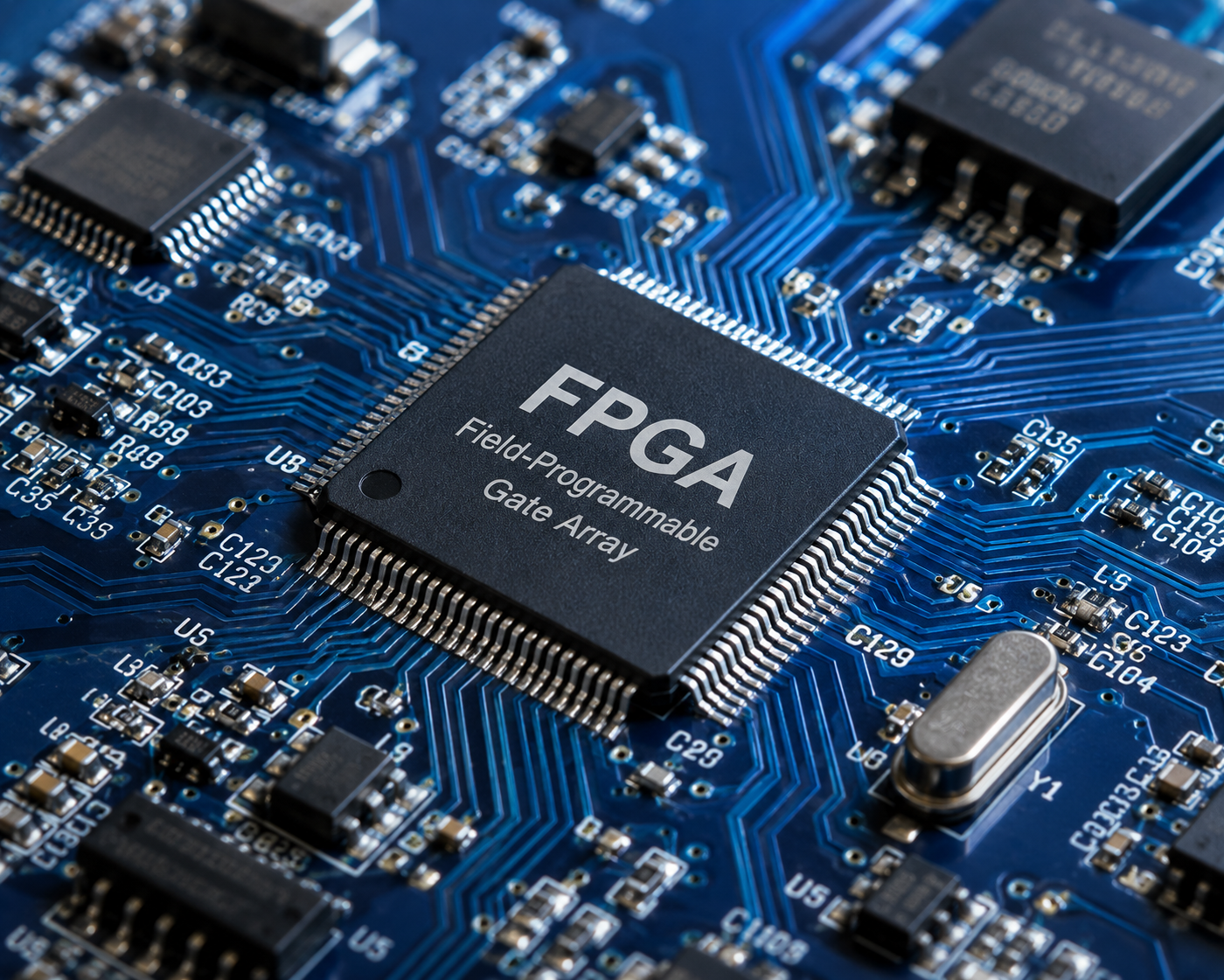
An FPGA is an integrated semiconductor device containing programmable logic blocks and configurable interconnections.
Unlike many conventional chips that have a predefined hardware architecture, an FPGA can be configured after manufacturing. Engineers use hardware description languages and development tools to define how the internal logic should operate.
This makes FPGA technology suitable for applications where hardware-level customization is important.
How Is an FPGA Different from a Microcontroller?
A microcontroller executes instructions sequentially through a processor architecture. It is highly useful for numerous embedded control applications.
An FPGA operates differently. Engineers can configure multiple logic operations to work in parallel.
This parallel architecture can provide significant advantages in applications involving:
- High-speed signal processing
- Multiple simultaneous operations
- Real-time data handling
- Custom communication protocols
- Hardware acceleration
The right choice ultimately depends on processing requirements, development complexity, cost and application design.
Common Applications of FPGA Technology
FPGA devices are used across many industries because their programmable architecture supports diverse applications.
Industrial automation: FPGA devices can support real-time machine control, high-speed interfaces and complex automation functions.
Telecommunications: They are frequently used for data processing, communication interfaces and signal management.
Image and video processing: Parallel processing capabilities make FPGAs useful for applications requiring rapid handling of large amounts of visual data.
Test and measurement equipment: Engineers can configure FPGA-based systems for specialized data acquisition and processing requirements.
Embedded electronics: FPGA technology can provide customized digital functionality for advanced embedded designs.
Key Advantages of Using an FPGA
One major benefit is flexibility. Hardware functionality can be configured according to the application rather than being completely fixed by the semiconductor manufacturer.
Other potential advantages include:
- Parallel processing capability
- High-speed operation
- Reconfigurable hardware
- Low-latency processing
- Custom digital interfaces
- Integration of multiple logic functions
However, FPGA selection requires careful engineering evaluation. Logic capacity, I/O requirements, memory resources, operating frequency, package type and development environment should all be considered.
FPGA Requirements for Electronics Projects in Delhi
Delhi NCR has a diverse electronics and engineering market covering industrial automation, embedded development, telecommunications, instrumentation and product development.
MAXGTECH serves the electronic components segment in Delhi, including requirements involving FPGA and other semiconductor technologies.
When evaluating an FPGA for a new project, buyers should avoid selecting a device solely according to price or logic capacity. The device must fit the complete architecture of the proposed system.
Choosing FPGA Technology for the Right Reason
FPGA devices are powerful because they give engineers greater control over hardware functionality. That flexibility, however, should be matched with clearly defined technical requirements.
For R&D teams, electronics manufacturers and system developers in Delhi, evaluating processing speed, interfaces, logic resources, development requirements and future scalability can help determine whether an FPGA is the appropriate solution for a particular electronic design.