Bipolar junction transistors remain important in countless electronic circuits despite the availability of newer semiconductor technologies. They are used for amplification, switching, signal conditioning, drivers, control circuits, and power applications.
When sourcing from a BJT Transistor Supplier, procurement teams should avoid treating devices with similar package sizes as equivalent. A BJT's electrical characteristics determine how it behaves within a circuit, and seemingly small specification differences can affect performance.
Start With Transistor Polarity
BJTs are broadly available as NPN and PNP devices.
The required polarity is determined by circuit design and cannot normally be substituted without corresponding circuit changes.
Before ordering, confirm the complete part number rather than relying on package markings or visual appearance.
Collector Emitter Voltage
The collector-emitter voltage rating indicates the maximum voltage the transistor can withstand under specified conditions.
Engineers generally include an appropriate margin above expected operating voltage. Transient conditions should also be considered in industrial circuits where switching loads can produce voltage spikes.
A transistor with insufficient voltage capability can experience excessive electrical stress.
Collector Current and Power Dissipation
Current capability is another key parameter, but it should be assessed together with power dissipation and thermal management.
A transistor operating near its maximum current may generate substantial heat depending on its operating mode.
Package size, PCB design, heatsinking, airflow, duty cycle, and ambient temperature all affect practical operating limits.
Current Gain Is Not Always Constant
BJT current gain, commonly represented as hFE or beta, can vary with collector current, temperature, and individual device characteristics.
Circuit designers should therefore avoid assuming that every transistor will operate at one fixed gain value.
For switching circuits, adequate base drive is important to achieve the required operating state. For analogue circuits, gain variation may need to be addressed through appropriate circuit design.
Switching Speed Matters in Some Applications
For low-frequency control functions, switching speed may not be particularly demanding. In higher-frequency circuits, storage time and transition characteristics become more important.
When replacing a discontinued or unavailable BJT, engineers should compare dynamic characteristics as well as basic voltage and current ratings.
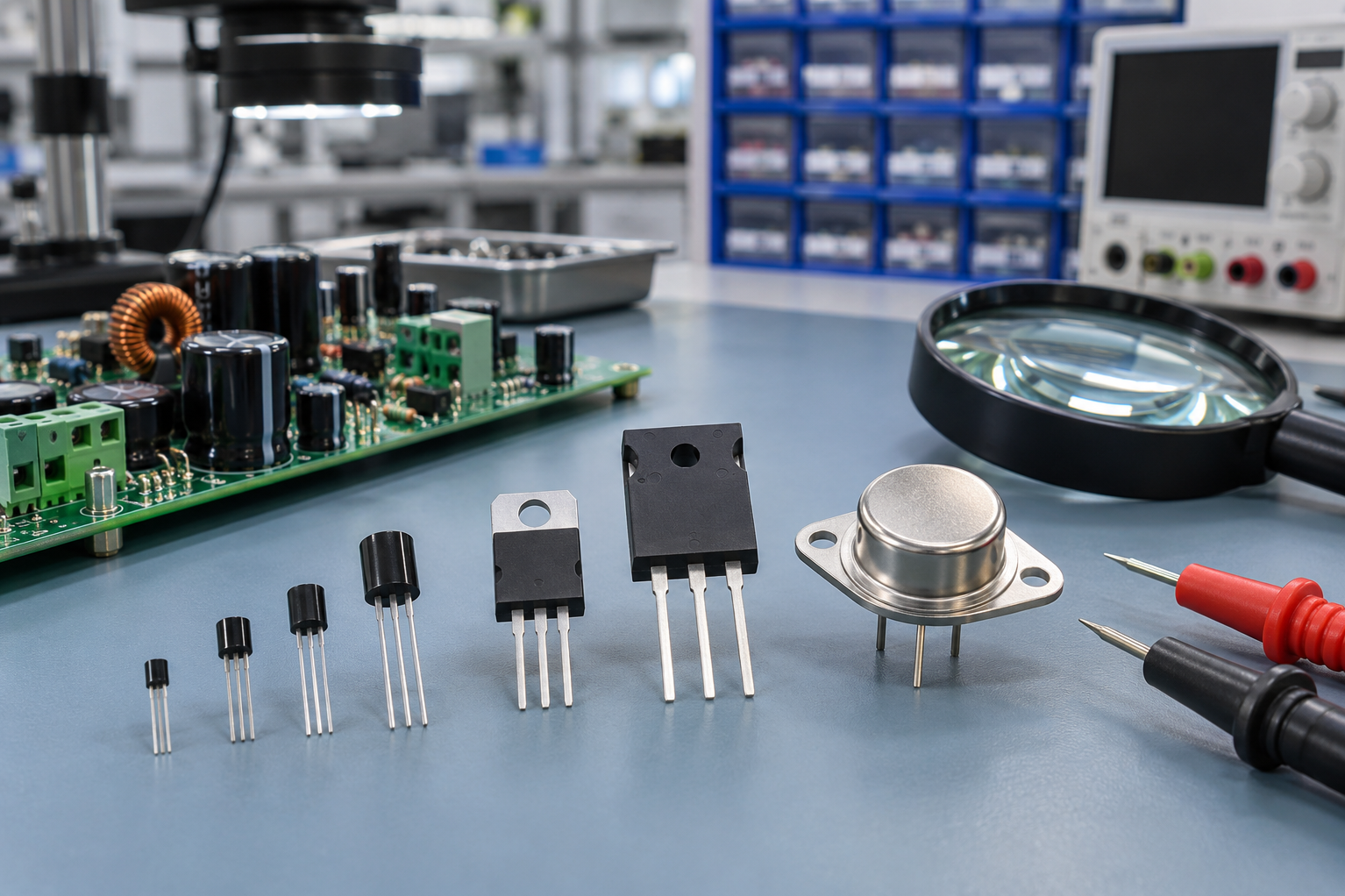
Package and Pin Configuration Need Verification
Two transistors can have comparable electrical ratings while using different pin arrangements.
This can create immediate PCB compatibility problems.
Before approving an alternative, check:
- Package type
- Pin configuration
- Mounting method
- Thermal characteristics
- Mechanical dimensions
These details are particularly important for existing products where PCB changes are undesirable.
Procurement Mistakes That Increase Risk
Common BJT sourcing mistakes include ordering from incomplete part numbers, assuming all devices in the same package are interchangeable, ignoring gain classifications, overlooking temperature ratings, and approving substitutes without engineering review.
For Delhi-based OEMs and electronics manufacturers, these errors can become expensive when components are purchased in production quantities.
MAXGTECH supports B2B electronic component requirements in Delhi, including transistor and semiconductor categories. Procurement teams approaching any supplier should provide complete part details and distinguish between an exact-match requirement and a request where alternatives may be technically evaluated.
Build an Approved Parts List
Manufacturers with recurring requirements can improve sourcing efficiency by maintaining an approved parts list.
The list can include the primary BJT, approved alternatives, manufacturer references, package details, important specifications, and application information.
This helps procurement teams respond faster when supply conditions change without making unverified substitutions.
A capable BJT Transistor Supplier should fit into this disciplined purchasing process. Price remains relevant, but correct identification, specification compatibility, availability, and repeatability are equally important.
When engineering and procurement teams evaluate these factors together, transistor sourcing becomes more reliable and production decisions become easier to manage.