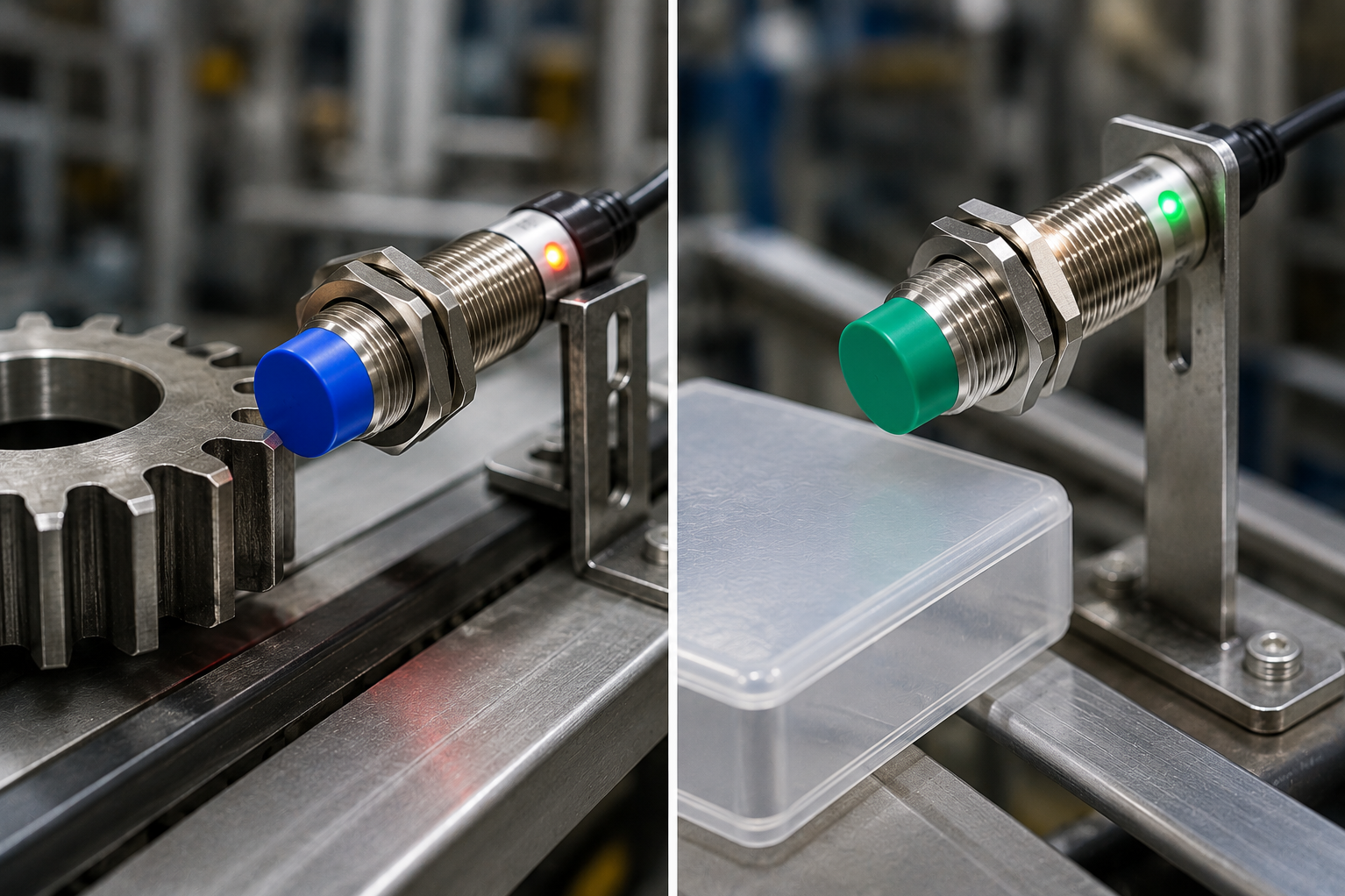
Proximity sensors allow machines and control systems to detect objects without requiring direct physical contact. Among the most widely considered options are inductive and capacitive proximity sensors.
Although both perform non-contact detection, they work on different principles and detect different types of materials. Understanding this distinction is essential when selecting sensors for industrial automation applications in Delhi.
What Is an Inductive Proximity Sensor?
An inductive proximity sensor is primarily designed to detect metallic objects.
The sensor generates an electromagnetic field around its sensing surface. When a suitable metal object enters this field, the resulting change is detected and converted into an output signal.
Common applications include:
- Metal component detection
- Machine position monitoring
- Gear and shaft detection
- Conveyor systems
- Production equipment
- Automated assembly lines
- Counting metallic objects
Because detection does not require mechanical contact, inductive sensors can be useful in repetitive industrial applications.
What Is a Capacitive Proximity Sensor?
A capacitive proximity sensor works by detecting changes in capacitance near its sensing area.
Unlike an inductive sensor, it can detect many metallic as well as non-metallic materials.
Depending on sensor specifications and application conditions, detectable materials may include:
- Plastic
- Glass
- Wood
- Paper
- Powder
- Granules
- Certain liquids
- Metal
This wider material-detection capability makes capacitive sensors useful in applications such as level detection and packaging processes.
Inductive or Capacitive: How Do You Decide?
The material being detected is usually the first consideration.
If the target is consistently metallic, an inductive proximity sensor is often a practical option.
When the target is non-metallic, a capacitive proximity sensor may be required.
However, material type should not be the only deciding factor.
Evaluate:
- Required sensing distance
- Target size
- Target material
- Mounting arrangement
- Environmental conditions
- Supply voltage
- Output configuration
- Switching frequency
Dust, moisture, surrounding materials and installation conditions can also affect sensor selection.
Avoid Choosing Sensors Only by Sensing Distance
A longer sensing distance does not automatically mean a sensor is better.
Industrial automation requires repeatable detection under actual operating conditions. The sensor must reliably identify the intended target without unwanted triggering from nearby objects or materials.
Mounting style is another important consideration. Flush and non-flush installation requirements can influence sensing behaviour and available detection range.
Proximity Sensors for Industrial Automation in Delhi
Delhi NCR supports numerous automation companies, machinery manufacturers, control panel builders and industrial equipment businesses. Proximity sensing is commonly required for machine sequencing, object detection, position monitoring and process automation.
MAXGTECH supports industrial electronic requirements in Delhi involving inductive proximity sensors, capacitive proximity sensors and related sensing components.
Before selecting a model, buyers should clearly define what must be detected, the sensing environment and the required electrical output.
Inductive and capacitive proximity sensors are not competing solutions for every application. Each has its own strengths. Matching the sensing technology with the target material and operating environment is the most dependable way to achieve consistent detection.